Sunday, September 14, 2014

Leadership St. Tammany Alumni Foundation: Forum on Mass Incarceration in the Parish

The New Jim Crow Task Force is pleased to support the forum on mass incarceration presented by the Leadership St. Tammany Foundation scheduled for October 7th. This forum represents the second such forum to be held in St. Tammany this year. In January, we facilitated "Safe and Fair Louisiana" with the ACLU, LA Sentencing Commission, and the Pelican Institute. We feel that the tide is changing and that it is very important that you show your support for this issue by attending the October 7th forum. See the details below.

Leadership St. Tammany Alumni Foundation
Presents
Leadership Revisited 2014
Unlocking the Keys to High Incarceration Rates and Their Impact in St. Tammany Parish
Where is the highest incarceration rate in the world? You might guess Russia, Iran, or North Korea. Shockingly, it is right here in Louisiana and specifically St. Tammany Parish. Join fellow alumni, as we explore why our parish has the highest incarceration rate in the world: its costs, human impacts, and possible solutions.
October 7, 2014
Pontchartrain Yacht Club
140 Jackson Street, Mandeville, LA
7:00 am – 8:00 am Registration/Breakfast/Networking
8:00 am – 11:30 am Program
$25 members & current class
$35 non-members/walk-ins $10 extra
Includes full breakfast, provided by Broken Egg Café.
Register by October 6, 2014
Questions: call Michael Sprague
Please print your tickets and present them at the door!


Friday, August 8, 2014

St. Tammany District Attorney Candidates Scheduled to Debate

District Attorney seats are up for re-election this November across the state of Louisiana.

The first debate between candidates for the St Tammany District Attorney Office is scheduled for Tuesday, August 26, at John Davis Center, 61100 North 12th St., Lacombe, at 6 PM. The candidates are Roy Burns, Alan Black, and Brian Trainor.

The District Attorney (Prosecutor) is the most powerful law enforcement official in the criminal justice system, even more than judges or sheriffs. The DA is free to dismiss a case, file more charges against an offender or transfer that case to a Federal Court. There is no oversight that requires him to assure racial or ethnic equality before the law.  He can cause an offender to plead guilty even if innocent by overcharging the offender.

The measure of a DA’s success may be the number of convictions they achieve. In St. Tammany that is 89%, mostly plea bargains not trial by jury. Perhaps this is the Why and the How Louisiana became the “Prison Capital of the World”.

Please plan to attend this candidate debate sponsored by Concerned Citizens of St. Tammany. 
           
Here are some questions that you can ask in addition to your own:

1.     What changes would you make to the structure of the office to help bolster public confidence in the DA’s office?
2.     What is your position regarding special courts (drug and mental health) and diversion programs that are designed to keep people out of jails and prisons?
3.     What is your position regarding the prosecution of individuals found with small amounts of marijuana?
4.     What can your office do to assist the formerly incarcerated to transition back into society?
5.     What changes will you make regarding your office’s policy on plea bargains, if any?
6.     Can you assure an ongoing review of charges across racial and ethnic groups to assure all segments of the community are treated equally?

7.     Do you feel that offenders understand the lifetime disadvantages (barriers to employment, housing, voting, licensing, access to education, food stamps, etc.) involved if they “plead” guilty to a felony?  

--Bonnie Schmidt           

related article:
"3 Announced St. Tammany DA Candidates Raised More than $148,000 in Latest Reporting," Heather Nolan, 06 August, 2014, nola.com.


Tuesday, April 15, 2014

CALL TO ACTION: Oppose SB 187--Adds more penalties, increases mass incarceration in the Prison Capital of the World

In the Prison Capital of the World, with some of the harshest drug laws for non-violent offenders, legislators continue to pile on laws that will exacerbate racial and class inequities in drug enforcement. Louisiana's RS 40:981.3 defines "drug-free zones" and states that any owner of property can designate a drug-free zone by posting a sign: this includes daycares, schools (private and public), public housing, religious buildings, drug treatment facilities. The drug free zone extends 2,000 feet from any such designated area. Up until now, private homes where no one under 17 is present were excluded from the drug-free zones. Senator Kostelka (R--District 25, includes Jackson, Lincoln, Ouachita parishes) is introducing a bill today--SB 187--that now includes private residences within those drug-free zones. The consequences of such a bill are apparent: urban areas--and especially the urban poor--will be most affected by this law. 

Note that the penalties are ENHANCED for those arrested for drugs in a drug-free zone. The Zone was extended from 1000 ft. to 2000 ft. some years ago. Now private homes will be considered in the drug free zone, no matter if a teenager is present or not. And those arrested in their private homes (apartments, public housing) can be charged 1 1/2 the maximum fine and 1 1/2 times the "longest term of imprisonment."

Please do what you can to communicate your opposition to this bill.

Here is the link to Judiciary C, where the bill will be discussed today: http://senate.la.gov/JudiciaryC/default.asp

Here is the link to the members of that committee: http://senate.la.gov/JudiciaryC/Assignments.asp

Here is a link to the bill: http://www.legis.la.gov/legis/ViewDocument.aspx?d=875684&n=SB187%20Original

For more information on the impact of drug-free zones on certain portions of the population, see: http://thinkprogress.org/justice/2014/04/14/3425658/the-true-price-of-drug-free-zones/


Wednesday, April 2, 2014

PICO-LA Faith Day Rally at the State Capitol

signs at the Faith Day rally against mass incarceration

Several members of the Northshore New Jim Crow Task Force--Bonnie Schmidt, Bev Mussen, Marlene Hahn, and Anita Dugat-Greene--joined PICO-Louisiana (People Improving Communities through Organizing) and other organizations, represented by several faith leaders and their congregants, on the steps of the state capitol on Tuesday, April 1st, to rally against mass incarceration. Lauren McGaughy, of The Times Picayune, has a report of the rally at the following link: "Faith leaders criticize Louisiana sentencing, prison policies." Several bills are moving through the state legislature during this legislative session that have the potential to help decrease the large prison population in Louisiana and to redress some serious inequities in the criminal justice system.

An eight-part investigative series in The Times Picayune in 2012 helped raise awareness of these issues, and forums in Louisiana towns have brought together people in a bi-partisan movement to reform the prison system. The eight part series in the Times Picayune can be found at the following link: "Louisiana Incarcerated: How We Built the World's Prison Capital."
The Faith Day group gathered on the front steps of the Louisiana state capitol

After the rally, the large group broke up into six smaller groups in order to meet with legislators. The NNJCTF members joined the group led by Dr. Lue Russell of Southern University. 

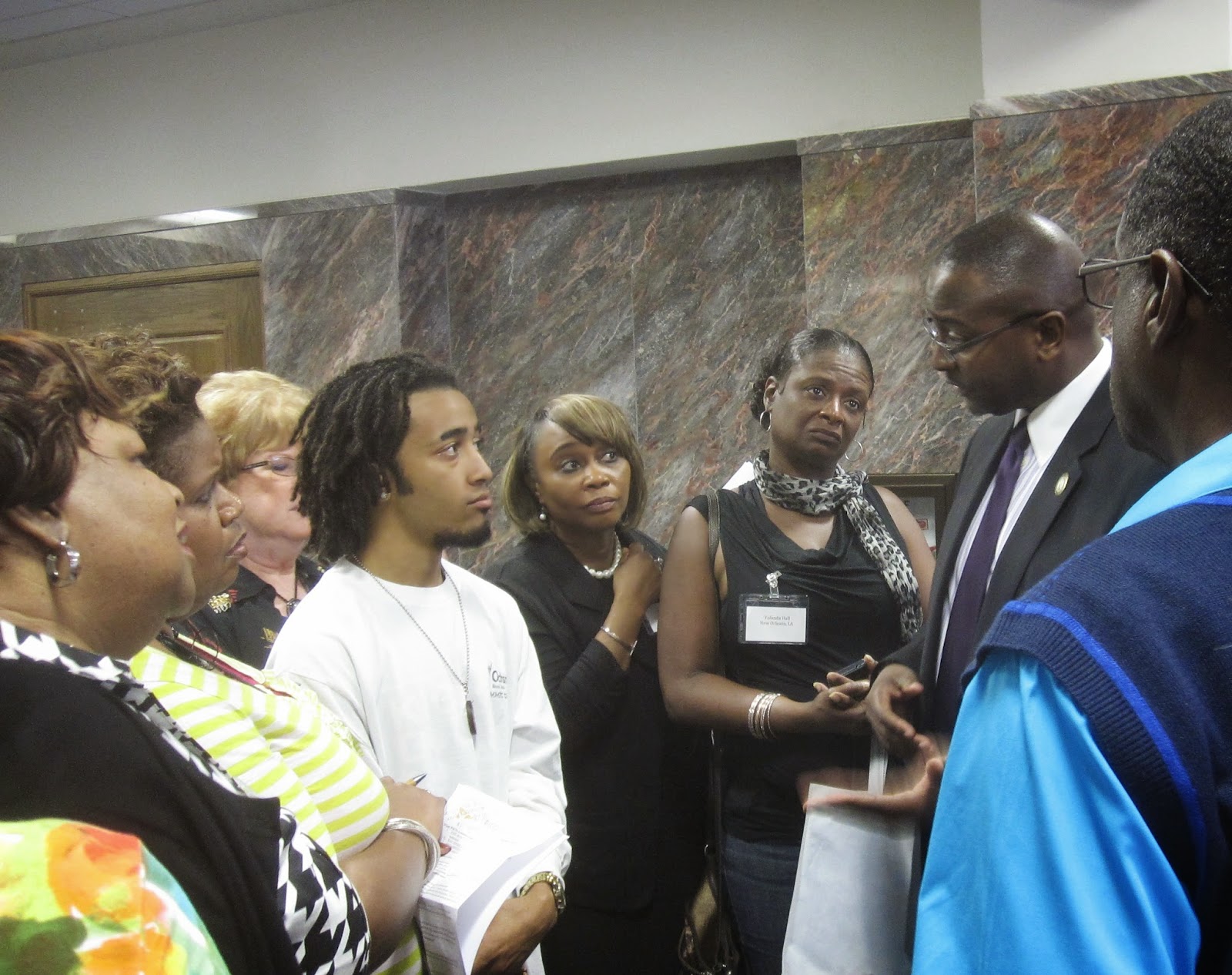
Of the two or three legislators Dr. Russell requested to leave committee meetings briefly to meet with the group, Rep. Patrick Jefferson (D-District 11) was able to answer the call. 
 
Rep. Patrick Jefferson (D-District 11) with Dr. Lue Russell and Bonnie Schmidt

Rep. Jefferson answers questions posed by a young man who participated in the rally
Rep. Jefferson agreed to support the bills that the group was focusing on today: 
  • SB 323 (reducing all penalties for marijuana possession); 
  • HB 745 (authorizing courts to waive mandatory minimum sentences in certain non-violent, non-sexual crimes); 
  • HB 217 and HB 485 (banning the box--requiring state contractors to avoid denying employment to ex-offenders based on criminal history alone; the seriousness of the offense and the time elapsed since the offense must be considered).
Members of PICO  discuss issues with Rep. Jefferson

Rep. John Bel Edwards was not able to meet with the group.

The participants in the rally then reconvened for a Research Action with Senator Elbert Guillory (R-24). Several persons in the audience were ready to ask questions that were prepared the day before in PICO's Boot Camp. One participant asked Rep. Guillory what propelled him into politics. In answering the question, Rep. Guillory described his first encounter with the law as a black teenager in Louisiana. He said that at the age of 15, he tried to borrow a book from the local library and was apprehended for violating a law that prohibited blacks from white-only libraries. 
Louisiana state senator Elbert Guillory (R-District 24) speaks to the members of the Faith Day rally at the state capitol
 Rep. Guillory assured the group that he would support the bills on which they were focusing during this visit to the state legislature, including the bill that would make possession of marijuana a misdemeanor. He reminded the group that three recent presidents had admitted to smoking marijuana in young adulthood. "If weed is a gateway drug," he said, "the gateway must be to the White House!"
Participants in the Faith Day rally listen to Rep. Patrick Jefferson
Dr. Lue Russell prepares to give instructions for meeting with a state legislator
A participant in the Faith Day rally has a question for Senator Guillory
Faith Day rally on the front steps of the Louisiana state capitol

Monday, February 24, 2014

NNJCTF Gears Up for the Louisiana 2014 Legislative Session

On February 23rd, ten people braved the downpour to attend the Northshore New Jim Crow Task Force's first meeting of the year at the Unitarian Universalist Church in Lacombe. The group was very happy to welcome two new faces, and after introductions, Bonnie Schmidt opened the meeting with a review of recent activities in which members had participated, specifically the PICO-LA meeting in New Orleans and the Together Louisiana meeting in Baton Rouge. The focus of the meeting, however, was on upcoming legislation in the Louisiana legislature and on making our voices heard in the legislative process. Bonnie reminded the group that legislators have until February 28th to file legislation and that the 2014 session begins on March 10th. Although there are many bills worthy of attention, the NNJCTF is focusing on:
  • Ban the Box for State Contracts Act (eliminating the felony conviction check-box on employment applications for certain state contractor jobs--HB 217, Smith)
  • Reclassifying marijuana possession as a misdemeanor  and reducing mandatory sentencing for marijuana possession: HB 130, Honore; HB 14, Badon (At the time of this writing, the link to the bill of HB14 was incorrectly directed on the Legislature's website; the link here is to the digest or abstract of the bill.)
We hope that passage of these bills will be a step in reducing the high incarceration rates in Louisiana, will allow for fairer and more equal sentencing, and will help ex-offenders returning to the work force.

During the remainder of the meeting, the group discussed ways to communicate our concerns effectively. As part of that discussion, we viewed a Ted Talk by Omar Ahmad, an activist and former mayor of San Carlos, California (link here: http://www.ted.com/talks/omar_ahmad_political_change_with_pen_and_paper) and shared the personal experiences that motivated each of us to become involved in the grass roots movement of prison and sentencing reform.

It is very important that we, as citizens, become informed and active in the political process. Please let your legislators know how you stand on these bills--and others--by writing, e-mailing, or calling your legislators.

Useful links:
  1. To find your Louisiana and U. S. Legislators: http://legis.la.gov/Legis/FindMyLegislators.aspx
  2. To find links that will direct you to the web page of your state senator and contact information: http://www.legis.la.gov/legis/Bios.aspx?cid=S
  3. To find links that will direct you to the web page of your representative and contact information: http://www.legis.la.gov/legis/Bios.aspx?cid=H 
  4.  To access an index of House and Senate numbered bills: http://legis.la.gov/legisdocs/billindex/14RSbillindex.pdf
  5. To follow the Louisiana House of Representatives on Twitter: https://twitter.com/louisianahouse/
  6. To follow the State Legislature on Twitter: https://twitter.com/lalegis

Thursday, February 13, 2014

The Corrupting Influence of Incarceration for Profit

Recently in a short piece in the business section of The New York Times, Eduardo Porter provided some cautionary advice about privatizing state-owned companies and government services. Caution is particularly important, he writes, in an age when loud voices in federal legislatures, state houses, and city halls are suggesting "privatizing everything from Medicare to the management of state parks as a possible solution to their budget woes." While privatization can sometimes "help achieve broad social goals," the profit motive can "directly undermine public policy goals." This is important to remember especially as so many of our states are privatizing prisons, ostensibly to save money. What seems to be happening, however, is that savings are ephemeral, non-existent, or lead to unethical or even criminal outcomes.

Here are stories, research, investigations that can perhaps help us--and convince others--to resist the loud and seductive voices of profit and privatization in the criminal justice system.

1. The story of the Pennsylvania judges who took millions of dollars in kickbacks in a juvenile detention scheme:
2. The Cash for Kids documentary that tells the story of the juveniles whose lives were ruined by  greed: showing 4:00 p.m., Saturday, March 8, at the Zeitgeist Theater in New Orleans.(See, also, our Events page for more information.)

or Amy Goodman's interviews with the young people and/or their parents affected by the profit scheme that two justices had with builders and owners of private prison facilities: "Kids for Cash: Inside One of the Nation's Most Shocking Juvenile Justice Scandals,"  Democracy Now!, 4 February 2014.

3. An exploration of how private prison profits impact people of color: "Higher Profits Explain Why There Are More People of Color in Private Prisons," Joshua Holland, Bill Moyers and Company, 7 February 2014.

4. Information on how the private prison industry lobbies for harsh penalties and longer sentences: "Private Prison Companies Want You Locked Up," Press Release, Justice Policy Institute, 22 June 2011.

 5. Reports on how contracts guaranteeing 80% to 100% occupancy affects profits and behavior of private prisons and the local and state governments that support them: "This is How Private Prison Companies Make Millions Even When Crime Rates Fall," by Andy Kroll, Mother Jones, 19 September 2013.
An editorial on the same, in the conservative Washington Times: "America's For-Profit Prisons: Greed over Justice," by Kevin J. Wells, 4 December 2013.

6. The ACLU's report "Banking on Bondage: Private Prisons and Mass Incarceration," 2 November 2011.

7. A CNBC investigation: Billions Behind Bars: Inside America's Prison Industry

These are just a few sources that demonstrate the serious problems of privatizing the criminal justice system. If the information here doesn't completely convince those who are ideologically committed to privatization, perhaps it can at least promote caution, careful re-consideration, and more just outcomes in how we deal with incarceration.

Friday, January 24, 2014

Update on the Safe and Fair Louisiana Forum

Left to right: Kevin Kane, Judge Ricky Wicker, Marjorie Esman
Last night, January 23rd, at the Abita Springs Town Hall, over 120 people attended a forum sponsored by the Pelican Institute and the ACLU. Ashley Rodrigue, of WWL TV, moderated the event, and the panelists were Marjorie R. Esman, Executive Director, ACLU of Louisiana; Kevin Kane, President, Pelican Institute for Public Policy; and the Honorable Judge Ricky Wicker, Louisiana Fifth Circuit Court of Appeals & LA Sentencing Project. The discussion centered around criminal justice reform, the feasibility of lowering Louisiana's high numbers of prison and jail populations while also reducing taxpayer expenses and improving public safety. A very lively question and answer session followed the opening remarks of the panelists.

Marjorie Esman focused her opening remarks on statistics associated with Louisiana's prisons. The latest data from 2012, she stated, indicates that Louisiana has 40,000 convicted inmates in state prisons and 30,000 people in parish jails, many of whom are awaiting trial. The state department of corrections budget is $700 million, and, as a parish example, the Orleans Parish sheriff's department's budget is $69 million. Of the 40,000 in prisons, she said, 37% have been convicted of violent crimes. Of the thousands who are sitting in jails waiting for trial, most are those who are too poor to afford to post bail. According to Ms. Esman, Louisiana is the only state that sentences up to 20 years for third-time charges of possessing marijuana. These statistics indicate that the system is broken and needs to be evaluated and reformed.

Kevin Kane spoke next, recounting how his interest in prison reform was spurred by an experience he had at a conference in Washington, D. C.. With its focus on the free market and "liberty-oriented policy solutions," the Pelican Institute, while non-partisan, is politically right of center.  As president of the Institute, he described his own politics similarly and himself as a law and order type of person. At this conference in D. C., however, he attended a session led by a group from Texas that described the escalating prison population in Texas and how in 2007, the state faced building three more prisons to house 17,000 more prisoners. These numbers startled Texas officials and concerned citizens into action, and Texas began to implement prison and sentencing reform. By 2011, the state was able to close a prison rather than build another one. Aware of Louisiana's own huge prison population, Mr. Kane said that he is interested in exploring the reforms that Texas and other states have implemented, with the hope that Louisiana can fashion similar reforms. He said that he would want to do so cautiously, without compromising public safety or trying anything new and untested.

Lastly, Judge Ricky Wicker focused on the work of the Louisiana Sentencing Commission [Go here for a pdf report on the Commission, its members, and its work: "Louisiana Sentencing Commission, March 2012]. The Commission, she said, comprises 22 people from "all spokes of the government wheel." Among the group's goals is to discover ways to implement programs [job training, drug rehab, revising parole eligibility for first-time non-violent offenders, etc.] that will result in lower recidivism. Preliminary steps in improving programming have already resulted in very incrementally reducing prison population.  She added, "If we engage in programming , our recidivism goes down."  Our prison system, she emphasized, cannot afford the costs of 40,000 prisoners in the state system and the additional 70,000 under supervision. She also emphasized the importance of gathering information on which to base the decisions of any prison reform--"We deal in numbers"--and said that all the judges are doing work from which the commission is gathering data.  Judge Wicker also praised individual judges who are looking at specific data and piloting new programs, and she pointed out the good work of public defenders and local law enforcement who were in the audience.
Ashley Rodrigue (WWL TV), Kevin Kane, Judge Ricky Wicker, Marjorie Esman
The lively question and answer period that followed these opening remarks included personal testimony from the audience as well as questions addressed to the panelists. Several of the attendees spoke of concerns of racial disparity in sentencing. Statistics gathered by various research organizations, including the Sentencing Commission of the federal government, have given credence to these concerns, and one audience member asked if the state of Louisiana had any recent studies on racial disparities in the state prison system. Judge Wicker replied that Louisiana has not done such a study since the 1980s. [This is particularly troubling, as the War on Drugs really took root in the 1980s, with the prison population dramatically increasing since that time, along with charges of racial disparity in drug charges and sentencing.]

Others in the audience were worried about the effect of private prisons on escalating incarceration rates, about the increasing population of the mentally ill in prisons and jails, and about inhuman treatment of prisoners in isolation. Acknowledging the frustrations of some of the audience members who spoke publicly, Judge Wicker said that change is difficult because "the culture in this country is for high sentencing" and that "it's hard to unravel that culture." Asked whether or not the state district attorneys were all on board with the work that the Louisiana Sentencing Commission is doing and the changes that might result, the judge replied that support varied. She also described how the public defender system in this state is severely under-funded and could benefit from re-purposing money in the criminal justice system. Marjorie Esman reminded the audience that they have the power of the vote, and if they are dissatisfied with the work of their judges, district attorneys, and sheriffs, they should go to the polls and rally their neighbors to do the same. Kevin Kane emphasized that the work of the Pelican Institute is to do research and to present good accurate information so that legislators and the public can make decisions.

This large turnout in St. Tammany Parish indicates a real interest in prison and sentencing reform, and we so appreciate the panelists' taking time to meet with the public in this venue. Thanks are also extended to members of the League of Women Voters and of the Northshore New Jim Crow Task Force for their cooperative efforts in advertising the forum, to the many other local organizations that assisted in promoting the event, and to the town of Abita Springs for making the facilities available.  We hope that local officials and legislators are aware of the concerns of all those present and that we will have other opportunities for such a stimulating exchange as we had at the Abita Springs Town Hall.
Signing the sign-up sheets before the forum begins
Citizens sign in to indicate their presence at the Safe and Fair Louisiana forum.
Crowd gathering in the Abita Springs Town Hall before the forum begins
before the forum begins
shortly before the forum begins


questions for the panel

questions for the panel
District Defender/Supervisor, John W. Linder, II
[photos and text: Anita Dugat-Greene]