In the Prison Capital of the World, with some of the harshest drug laws
for non-violent offenders, legislators continue to pile on laws that
will exacerbate racial and class inequities in drug enforcement.
Louisiana's RS 40:981.3 defines "drug-free zones" and states that any
owner of property can designate a drug-free zone by posting a sign: this
includes daycares, schools (private and public), public housing,
religious buildings, drug treatment facilities. The drug free zone
extends 2,000 feet from any such designated area. Up until now, private
homes where no one under 17 is present were excluded from the drug-free
zones. Senator Kostelka (R--District 25, includes Jackson,
Lincoln, Ouachita parishes) is introducing a bill today--SB 187--that
now includes private residences within those drug-free zones. The
consequences of such a bill are apparent: urban areas--and especially
the urban poor--will be most affected by this law.
Note
that the penalties are ENHANCED for those arrested for drugs in a
drug-free zone. The Zone was extended from 1000 ft. to 2000 ft. some
years ago. Now private homes will be considered in the drug free zone,
no matter if a teenager is present or not.
And those arrested in their private homes (apartments, public housing) can be charged 1 1/2 the maximum fine and 1 1/2 times the
"longest term of imprisonment."
Please do what you
can to communicate your opposition to this bill.
Here is the link to Judiciary C, where the bill will be discussed today: http://senate.la.gov/JudiciaryC/default.asp
Here is the link to the members of that committee: http://senate.la.gov/JudiciaryC/Assignments.asp
Here is a link to the bill: http://www.legis.la.gov/legis/ViewDocument.aspx?d=875684&n=SB187%20Original
For more information on the impact of drug-free zones on certain portions of the population, see: http://thinkprogress.org/justice/2014/04/14/3425658/the-true-price-of-drug-free-zones/
Showing posts with label Louisiana prison reform. Show all posts
Showing posts with label Louisiana prison reform. Show all posts
Tuesday, April 15, 2014

Wednesday, April 2, 2014
PICO-LA Faith Day Rally at the State Capitol
 |
| signs at the Faith Day rally against mass incarceration |
Several members of the Northshore New Jim Crow Task Force--Bonnie Schmidt, Bev Mussen, Marlene Hahn, and Anita Dugat-Greene--joined PICO-Louisiana (People Improving Communities through Organizing) and other organizations, represented by several faith leaders and their congregants, on the steps of the state capitol on Tuesday, April 1st, to rally against mass incarceration. Lauren McGaughy, of The Times Picayune, has a report of the rally at the following link: "Faith leaders criticize Louisiana sentencing, prison policies." Several bills are moving through the state legislature during this legislative session that have the potential to help decrease the large prison population in Louisiana and to redress some serious inequities in the criminal justice system.
An eight-part investigative series in The Times Picayune in 2012 helped raise awareness of these issues, and forums in Louisiana towns have brought together people in a bi-partisan movement to reform the prison system. The eight part series in the Times Picayune can be found at the following link: "Louisiana Incarcerated: How We Built the World's Prison Capital."
 |
| The Faith Day group gathered on the front steps of the Louisiana state capitol |
After the rally, the large group broke up into six smaller groups in order to meet with legislators. The NNJCTF members joined the group led by Dr. Lue Russell of Southern University.
Of the two or three legislators Dr. Russell requested to leave committee meetings briefly to meet with the group, Rep. Patrick Jefferson (D-District 11) was able to answer the call.
 |
| Rep. Patrick Jefferson (D-District 11) with Dr. Lue Russell and Bonnie Schmidt |
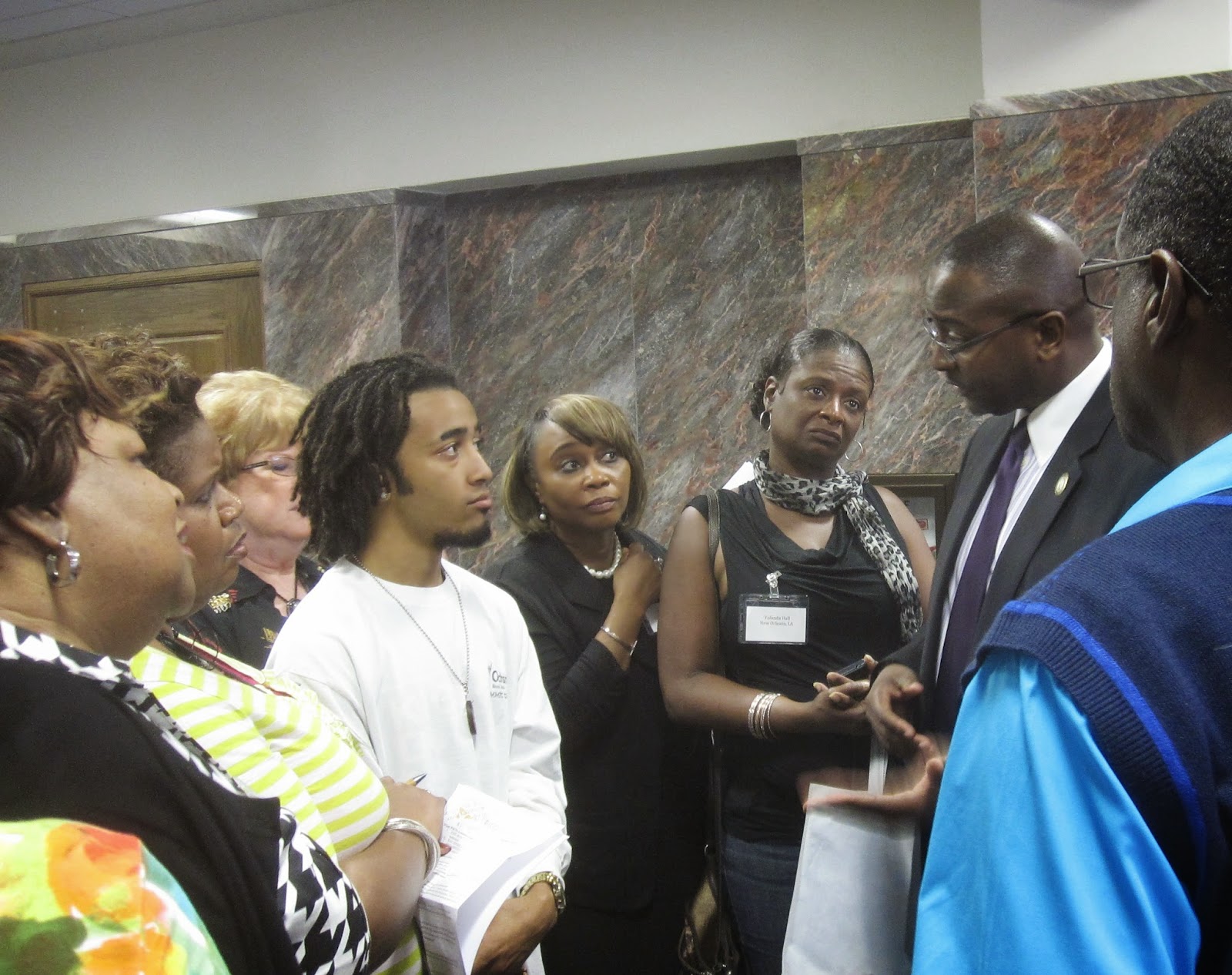 |
| Rep. Jefferson answers questions posed by a young man who participated in the rally |
- SB 323 (reducing all penalties for marijuana possession);
- HB 745 (authorizing courts to waive mandatory minimum sentences in certain non-violent, non-sexual crimes);
- HB 217 and HB 485 (banning the box--requiring state contractors to avoid denying employment to ex-offenders based on criminal history alone; the seriousness of the offense and the time elapsed since the offense must be considered).
 |
| Members of PICO discuss issues with Rep. Jefferson |
Rep. John Bel Edwards was not able to meet with the group.
 |
| Louisiana state senator Elbert Guillory (R-District 24) speaks to the members of the Faith Day rally at the state capitol |
 |
| Participants in the Faith Day rally listen to Rep. Patrick Jefferson |
 |
| Dr. Lue Russell prepares to give instructions for meeting with a state legislator |
 |
| A participant in the Faith Day rally has a question for Senator Guillory |
 |
| Faith Day rally on the front steps of the Louisiana state capitol |
Monday, February 24, 2014
NNJCTF Gears Up for the Louisiana 2014 Legislative Session
On February 23rd, ten people braved the downpour to attend the Northshore New Jim Crow Task Force's first meeting of the year at the Unitarian Universalist Church in Lacombe. The group was very happy to welcome two new faces, and after introductions, Bonnie Schmidt opened the meeting with a review of recent activities in which members had participated, specifically the PICO-LA meeting in New Orleans and the Together Louisiana meeting in Baton Rouge. The focus of the meeting, however, was on upcoming legislation in the Louisiana legislature and on making our voices heard in the legislative process. Bonnie reminded the group that legislators have until February 28th to file legislation and that the 2014 session begins on March 10th. Although there are many bills worthy of attention, the NNJCTF is focusing on:
During the remainder of the meeting, the group discussed ways to communicate our concerns effectively. As part of that discussion, we viewed a Ted Talk by Omar Ahmad, an activist and former mayor of San Carlos, California (link here: http://www.ted.com/talks/omar_ahmad_political_change_with_pen_and_paper) and shared the personal experiences that motivated each of us to become involved in the grass roots movement of prison and sentencing reform.
It is very important that we, as citizens, become informed and active in the political process. Please let your legislators know how you stand on these bills--and others--by writing, e-mailing, or calling your legislators.
Useful links:
- Ban the Box for State Contracts Act (eliminating the felony conviction check-box on employment applications for certain state contractor jobs--HB 217, Smith)
- Reclassifying marijuana possession as a misdemeanor and reducing mandatory sentencing for marijuana possession: HB 130, Honore; HB 14, Badon (At the time of this writing, the link to the bill of HB14 was incorrectly directed on the Legislature's website; the link here is to the digest or abstract of the bill.)
During the remainder of the meeting, the group discussed ways to communicate our concerns effectively. As part of that discussion, we viewed a Ted Talk by Omar Ahmad, an activist and former mayor of San Carlos, California (link here: http://www.ted.com/talks/omar_ahmad_political_change_with_pen_and_paper) and shared the personal experiences that motivated each of us to become involved in the grass roots movement of prison and sentencing reform.
It is very important that we, as citizens, become informed and active in the political process. Please let your legislators know how you stand on these bills--and others--by writing, e-mailing, or calling your legislators.
Useful links:
- To find your Louisiana and U. S. Legislators: http://legis.la.gov/Legis/FindMyLegislators.aspx
- To find links that will direct you to the web page of your state senator and contact information: http://www.legis.la.gov/legis/Bios.aspx?cid=S
- To find links that will direct you to the web page of your representative and contact information: http://www.legis.la.gov/legis/Bios.aspx?cid=H
- To access an index of House and Senate numbered bills: http://legis.la.gov/legisdocs/billindex/14RSbillindex.pdf
- To follow the Louisiana House of Representatives on Twitter: https://twitter.com/louisianahouse/
- To follow the State Legislature on Twitter: https://twitter.com/lalegis
Friday, January 24, 2014
Update on the Safe and Fair Louisiana Forum
 |
| Left to right: Kevin Kane, Judge Ricky Wicker, Marjorie Esman |
Marjorie Esman focused her opening remarks on statistics associated with Louisiana's prisons. The latest data from 2012, she stated, indicates that Louisiana has 40,000 convicted inmates in state prisons and 30,000 people in parish jails, many of whom are awaiting trial. The state department of corrections budget is $700 million, and, as a parish example, the Orleans Parish sheriff's department's budget is $69 million. Of the 40,000 in prisons, she said, 37% have been convicted of violent crimes. Of the thousands who are sitting in jails waiting for trial, most are those who are too poor to afford to post bail. According to Ms. Esman, Louisiana is the only state that sentences up to 20 years for third-time charges of possessing marijuana. These statistics indicate that the system is broken and needs to be evaluated and reformed.
Kevin Kane spoke next, recounting how his interest in prison reform was spurred by an experience he had at a conference in Washington, D. C.. With its focus on the free market and "liberty-oriented policy solutions," the Pelican Institute, while non-partisan, is politically right of center. As president of the Institute, he described his own politics similarly and himself as a law and order type of person. At this conference in D. C., however, he attended a session led by a group from Texas that described the escalating prison population in Texas and how in 2007, the state faced building three more prisons to house 17,000 more prisoners. These numbers startled Texas officials and concerned citizens into action, and Texas began to implement prison and sentencing reform. By 2011, the state was able to close a prison rather than build another one. Aware of Louisiana's own huge prison population, Mr. Kane said that he is interested in exploring the reforms that Texas and other states have implemented, with the hope that Louisiana can fashion similar reforms. He said that he would want to do so cautiously, without compromising public safety or trying anything new and untested.
Lastly, Judge Ricky Wicker focused on the work of the Louisiana Sentencing Commission [Go here for a pdf report on the Commission, its members, and its work: "Louisiana Sentencing Commission, March 2012]. The Commission, she said, comprises 22 people from "all spokes of the government wheel." Among the group's goals is to discover ways to implement programs [job training, drug rehab, revising parole eligibility for first-time non-violent offenders, etc.] that will result in lower recidivism. Preliminary steps in improving programming have already resulted in very incrementally reducing prison population. She added, "If we engage in programming , our recidivism goes down." Our prison system, she emphasized, cannot afford the costs of 40,000 prisoners in the state system and the additional 70,000 under supervision. She also emphasized the importance of gathering information on which to base the decisions of any prison reform--"We deal in numbers"--and said that all the judges are doing work from which the commission is gathering data. Judge Wicker also praised individual judges who are looking at specific data and piloting new programs, and she pointed out the good work of public defenders and local law enforcement who were in the audience.
 |
| Ashley Rodrigue (WWL TV), Kevin Kane, Judge Ricky Wicker, Marjorie Esman |
Others in the audience were worried about the effect of private prisons on escalating incarceration rates, about the increasing population of the mentally ill in prisons and jails, and about inhuman treatment of prisoners in isolation. Acknowledging the frustrations of some of the audience members who spoke publicly, Judge Wicker said that change is difficult because "the culture in this country is for high sentencing" and that "it's hard to unravel that culture." Asked whether or not the state district attorneys were all on board with the work that the Louisiana Sentencing Commission is doing and the changes that might result, the judge replied that support varied. She also described how the public defender system in this state is severely under-funded and could benefit from re-purposing money in the criminal justice system. Marjorie Esman reminded the audience that they have the power of the vote, and if they are dissatisfied with the work of their judges, district attorneys, and sheriffs, they should go to the polls and rally their neighbors to do the same. Kevin Kane emphasized that the work of the Pelican Institute is to do research and to present good accurate information so that legislators and the public can make decisions.
This large turnout in St. Tammany Parish indicates a real interest in prison and sentencing reform, and we so appreciate the panelists' taking time to meet with the public in this venue. Thanks are also extended to members of the League of Women Voters and of the Northshore New Jim Crow Task Force for their cooperative efforts in advertising the forum, to the many other local organizations that assisted in promoting the event, and to the town of Abita Springs for making the facilities available. We hope that local officials and legislators are aware of the concerns of all those present and that we will have other opportunities for such a stimulating exchange as we had at the Abita Springs Town Hall.
 |
| Signing the sign-up sheets before the forum begins |
 |
| Citizens sign in to indicate their presence at the Safe and Fair Louisiana forum. |
 |
| Crowd gathering in the Abita Springs Town Hall before the forum begins |
 |
| before the forum begins |
 |
| shortly before the forum begins |
 |
| questions for the panel |
 |
| questions for the panel |
 |
| District Defender/Supervisor, John W. Linder, II |
House Committee Informational Session on Legalizing Marijuana for Medical Use
On Tuesday, January 21st, of this week, Sandra Slifer, President of the League of Women Voters of Louisiana, and two members of the Northshore New Jim Crow Task Force, Bonnie Schmidt and Anita Dugat-Greene, carpooled to Baton Rouge to attend the afternoon session of the Louisiana House of Representatives Administration of Criminal Justice Committee. Representative Dalton Honoré had requested this session "to discuss the feasibility of legalizing marijuana for medical use" ("Louisiana lawmakers hear case for legalizing medical, recreational marijuana," Lauren McGaughey, The Times Picayune, 22 January 2014). Shortly before the session was to begin at 1:30 p.m., the room quickly filled with observers, those who had come to listen and those who planned to speak when the microphone was opened to the public. [links to the videotaped and archived session below]
Chairman Joseph Lopinto called the meeting to order, reminded the crowd that the session was for gathering information, and gave brief instructions for those who wished to speak publicly. Rep. Honoré opened the session with background on the two years of discussion and study that he and others have given to the subject of the state's laws on marijuana use. His purpose today, he said, was to focus on discussing the medical use of marijuana. He reminded his colleagues and the audience that in 1991, Louisiana had passed a law allowing doctors to prescribe marijuana for limited medical use but had not followed through with any legislation that would allow those prescriptions to be filled. As an article in The Advocate states
The New Jim Task Force is most concerned with Louisiana's harsh penalties for non-violent drug offenders, among the harshest laws--perhaps the harshest--in the United States, with third-time marijuana offenders facing up to twenty years in prison. The punishment seems too harsh for the crime, and, in addition, there is ample evidence to suggest that penalties are not racially neutral. According to The Wall Street Journal, a report issued in February of 2013 by the Federal Sentencing Committee found that between December 2007 and September 2011, sentences of African American men were 19.5% longer than those for whites convicted of the same crimes and that African American men "were 25% less likely than whites in the same period to receive a sentence below the guideline's range." These are federal statistics.
The Northshore New Jim Crow Task Force members who attended this session of the Administration of Criminal Justice Committee were impressed once again with the importance of public engagement in civic discourse, and we strongly encourage our fellow citizens to stay informed, to attend open meetings in the state capitol, and to communicate their concerns to their legislators. Many people at this meeting spoke passionately of their concerns, and for this limited time, at least, legislators heard their voices.
Access to the Archived Video of Chamber and Committees The sessions in the Louisiana legislature are often broadcast live and the videos later archived and accessible online: You can access the session for January 21, 2014, 1:30 p.m., by going directly to the archived website at http://house.louisiana.gov/h_video/2014/Jan2014.htm. Scroll down to the entries for Jan. 21, 2014, and click on the third item in the list "Criminal Justice," dated Jan 21, 01:30 PM HCR-6.
For more information:
Lauren McGaughy, "Louisiana lawmakers hear case for legalizing medical, recreational marijuana," The Times-Picayune, 21 January 2014.
Alex Woodward, "Louisiana's Week in Marijuana," Gambit, 23 January 2014.
Marsha Shuler, "Legislators Urged to Consider Lesser Penalties,"The Advocate, 23 January 2014.
Chairman Joseph Lopinto called the meeting to order, reminded the crowd that the session was for gathering information, and gave brief instructions for those who wished to speak publicly. Rep. Honoré opened the session with background on the two years of discussion and study that he and others have given to the subject of the state's laws on marijuana use. His purpose today, he said, was to focus on discussing the medical use of marijuana. He reminded his colleagues and the audience that in 1991, Louisiana had passed a law allowing doctors to prescribe marijuana for limited medical use but had not followed through with any legislation that would allow those prescriptions to be filled. As an article in The Advocate states
The 1991 statute calls for patients suffering from glaucoma, chemotherapy treatments and spastic quadriplegia to receive marijuana for therapeutic use. The statute hinged on the secretary of health and hospitals promulgating rules and regulations by Jan. 1, 1992. Apparently, those rules and regulations never materialized.( "Governor open to availability under law under 'very strict supervision,'" Michelle Millhollen and Mark Ballard, The Advocate, 23 January 2014)Rep. Honoré also described that as a (now retired) law enforcement officer, he had arrested people who consequently were sentenced to prison for marijuana use or distribution but that the public's attitude toward the drug has changed over the years, with other states decriminalizing marijuana or making it legal. He was here in this session, however, not to advocate for the legalization of marijuana for recreational use but for following through with the 1991 law, asking for medical acceptance of marijuana so that people could get their prescriptions filled. After his opening comments, he ceded the floor to various public officials and private citizens. Among the most moving testimonies were those of people with chronic conditions that could be relieved by marijuana use and of parents of children with severe epileptic episodes whose symptoms they believed could also be reduced by medically prescribed marijuana. Advocates spoke for and against legalizing the use of marijuana for medical or recreational purposes, but those in favor of easing the restrictive Louisiana laws were by far in the majority.
The New Jim Task Force is most concerned with Louisiana's harsh penalties for non-violent drug offenders, among the harshest laws--perhaps the harshest--in the United States, with third-time marijuana offenders facing up to twenty years in prison. The punishment seems too harsh for the crime, and, in addition, there is ample evidence to suggest that penalties are not racially neutral. According to The Wall Street Journal, a report issued in February of 2013 by the Federal Sentencing Committee found that between December 2007 and September 2011, sentences of African American men were 19.5% longer than those for whites convicted of the same crimes and that African American men "were 25% less likely than whites in the same period to receive a sentence below the guideline's range." These are federal statistics.
The Northshore New Jim Crow Task Force members who attended this session of the Administration of Criminal Justice Committee were impressed once again with the importance of public engagement in civic discourse, and we strongly encourage our fellow citizens to stay informed, to attend open meetings in the state capitol, and to communicate their concerns to their legislators. Many people at this meeting spoke passionately of their concerns, and for this limited time, at least, legislators heard their voices.
Access to the Archived Video of Chamber and Committees The sessions in the Louisiana legislature are often broadcast live and the videos later archived and accessible online: You can access the session for January 21, 2014, 1:30 p.m., by going directly to the archived website at http://house.louisiana.gov/h_video/2014/Jan2014.htm. Scroll down to the entries for Jan. 21, 2014, and click on the third item in the list "Criminal Justice," dated Jan 21, 01:30 PM HCR-6.
For more information:
Lauren McGaughy, "Louisiana lawmakers hear case for legalizing medical, recreational marijuana," The Times-Picayune, 21 January 2014.
Alex Woodward, "Louisiana's Week in Marijuana," Gambit, 23 January 2014.
Marsha Shuler, "Legislators Urged to Consider Lesser Penalties,"The Advocate, 23 January 2014.
Monday, January 20, 2014
On MLK Day, Commitment and Leadership Necessary for Solutions
Here are some disturbing statistics. According to The Sentencing Project, "More than 60% of the people in prison are now racial and ethnic minorities," and "two-thirds of all persons in prison for drug offenses are people of color." These disproportionate numbers indicate a serious problem in the criminal justice system, a problem that begins with many people of color at an early age, for a report by the National Council of Crime and Delinquency shows that
The "Safe and Fair Louisiana" forum scheduled this week at the Abita Springs Town Hall is one outcome of this movement to guarantee equal justice for all. The event, sponsored by The Pelican Institute and the Louisiana chapter of the American Civil Liberties Union, will take place on Thursday, 23 January, at 7 p.m.. We are looking forward to the panelists' educating the public about the issue and discussing solutions.
Of course, we also have years of research available that demonstrate that early childhood education for at-risk populations is one way of addressing the potentiality of criminalization. Providing people with a good education (click here for a well-known study) has long been recognized as a deterrent to crime. We know this, and yet there is always political resistance to increasing funding to childhood education programs such as Head Start. We know this, and yet support of good public schools continues to be eroded. As one of our own local leaders, Bishop E. René Soulé, says:
video below accessed first from ActionNews17 website. See also, Northshore Black Elected Officials Coalition and Associates.
the juvenile justice system is anything but equal for all. Throughout the system, youth of color--especially African American youth— receive different and harsher treatment for similar offenses.The report explores the disparities in justice meted out to whites and to minority populations. Anyone concerned about justice in our country should be concerned about these disparities, disparities that show up throughout the criminal justice system, beyond youth detention. Concerned citizens and legislators are coming together to address the issue and to offer solutions. Community support--local commitment and leadership, as well as national--is the first step. And that's what we are beginning to see in Louisiana--people joining together to look for solutions to this state's high incarceration rate.
The "Safe and Fair Louisiana" forum scheduled this week at the Abita Springs Town Hall is one outcome of this movement to guarantee equal justice for all. The event, sponsored by The Pelican Institute and the Louisiana chapter of the American Civil Liberties Union, will take place on Thursday, 23 January, at 7 p.m.. We are looking forward to the panelists' educating the public about the issue and discussing solutions.
Of course, we also have years of research available that demonstrate that early childhood education for at-risk populations is one way of addressing the potentiality of criminalization. Providing people with a good education (click here for a well-known study) has long been recognized as a deterrent to crime. We know this, and yet there is always political resistance to increasing funding to childhood education programs such as Head Start. We know this, and yet support of good public schools continues to be eroded. As one of our own local leaders, Bishop E. René Soulé, says:
When we are willing to invest our tax dollars in incarceration, which has a small return on investment, instead of education, which has a huge return on investment, there is a priority problem at the state level.Perhaps with leadership and public commitment, Louisiana can shed its dubious distinction as the prison capital of the world.
video below accessed first from ActionNews17 website. See also, Northshore Black Elected Officials Coalition and Associates.
Friday, January 10, 2014
Safe & Fair Louisiana: A Forum on Criminal Justice Reform
As other writers have noted, Louisiana has the highest incarceration rate not only in the United States but in the world. Its incarceration rate is "nearly five times Iran's, 13 times China's and 20 times Germany's," as an investigation by Cindy Chang, of the New Orleans-Times Picayune, reveals. According to the National Institution of Corrections, in 2010, Louisiana had a rate "about 115% higher than the national average of incarcerated (in prison) adults per 100,000." The social and economic costs of this high incarceration rate have captured the attention and concern of citizens and politicians alike, on both sides of the political aisle, and a nonpartisan movement to address these costs is gathering momentum.
The ACLU of Louisiana and the Pelican Institute for Public Policy have joined together to explore whether or not policymakers can take steps to lower the prison population and reduce taxpayer expense while improving public safety. Last fall the two organizations sponsored panel discussions about the costs of mass incarceration in Louisiana. The first forum was held on the University of New Orleans' Jefferson campus and the second in Lafayette on the South Louisiana Community College campus. Now the two organizations will be presenting a similar panel discussion on the Northshore.
This upcoming forum, sponsored by the ACLU of Louisiana and the Pelican Institute for Public Policy, will be moderated by Ashley Rodrigue of WWL. Panelists include Majorie R. Esman, Executive Director, ACLU of Louisiana; Kevin Kane, President, Pelican Institute; and Ricky Wicker, Judge, Louisiana Sentencing Commission.
The forum will take place on Thursday, January 23, 2014, at 7:00 p.m., at the Abita Springs Town Hall, 22161 Level St., Abita Springs, LA.
The forum is free and open to the public.
The ACLU of Louisiana and the Pelican Institute for Public Policy have joined together to explore whether or not policymakers can take steps to lower the prison population and reduce taxpayer expense while improving public safety. Last fall the two organizations sponsored panel discussions about the costs of mass incarceration in Louisiana. The first forum was held on the University of New Orleans' Jefferson campus and the second in Lafayette on the South Louisiana Community College campus. Now the two organizations will be presenting a similar panel discussion on the Northshore.
This upcoming forum, sponsored by the ACLU of Louisiana and the Pelican Institute for Public Policy, will be moderated by Ashley Rodrigue of WWL. Panelists include Majorie R. Esman, Executive Director, ACLU of Louisiana; Kevin Kane, President, Pelican Institute; and Ricky Wicker, Judge, Louisiana Sentencing Commission.
The forum will take place on Thursday, January 23, 2014, at 7:00 p.m., at the Abita Springs Town Hall, 22161 Level St., Abita Springs, LA.
The forum is free and open to the public.
Subscribe to:
Posts (Atom)