Showing posts with label prison industrial complex. Show all posts

Wednesday, April 2, 2014

PICO-LA Faith Day Rally at the State Capitol

signs at the Faith Day rally against mass incarceration

Several members of the Northshore New Jim Crow Task Force--Bonnie Schmidt, Bev Mussen, Marlene Hahn, and Anita Dugat-Greene--joined PICO-Louisiana (People Improving Communities through Organizing) and other organizations, represented by several faith leaders and their congregants, on the steps of the state capitol on Tuesday, April 1st, to rally against mass incarceration. Lauren McGaughy, of The Times Picayune, has a report of the rally at the following link: "Faith leaders criticize Louisiana sentencing, prison policies." Several bills are moving through the state legislature during this legislative session that have the potential to help decrease the large prison population in Louisiana and to redress some serious inequities in the criminal justice system.

An eight-part investigative series in The Times Picayune in 2012 helped raise awareness of these issues, and forums in Louisiana towns have brought together people in a bi-partisan movement to reform the prison system. The eight part series in the Times Picayune can be found at the following link: "Louisiana Incarcerated: How We Built the World's Prison Capital."
The Faith Day group gathered on the front steps of the Louisiana state capitol

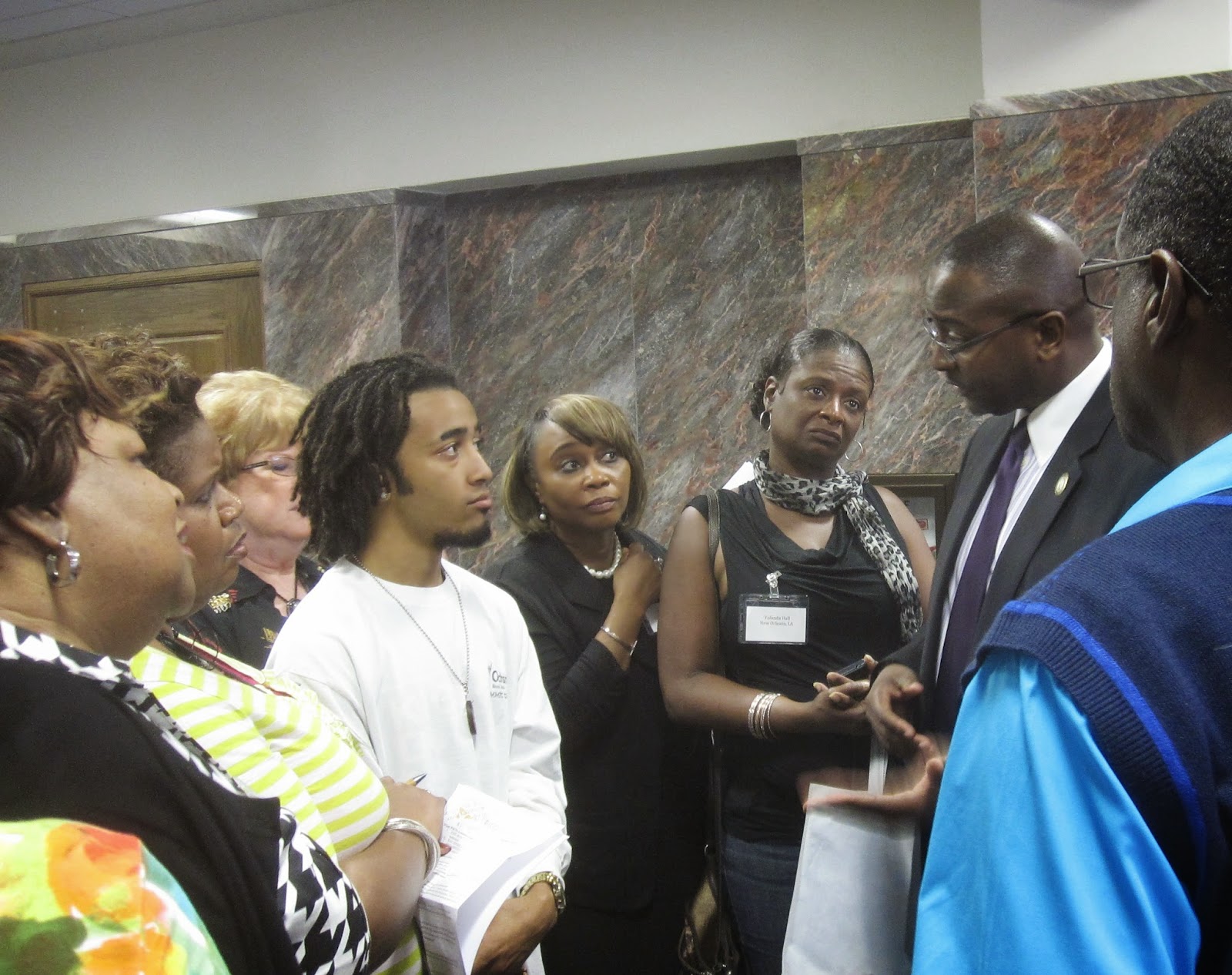
After the rally, the large group broke up into six smaller groups in order to meet with legislators. The NNJCTF members joined the group led by Dr. Lue Russell of Southern University. 

Of the two or three legislators Dr. Russell requested to leave committee meetings briefly to meet with the group, Rep. Patrick Jefferson (D-District 11) was able to answer the call. 
 
Rep. Patrick Jefferson (D-District 11) with Dr. Lue Russell and Bonnie Schmidt

Rep. Jefferson answers questions posed by a young man who participated in the rally
Rep. Jefferson agreed to support the bills that the group was focusing on today: 
  • SB 323 (reducing all penalties for marijuana possession); 
  • HB 745 (authorizing courts to waive mandatory minimum sentences in certain non-violent, non-sexual crimes); 
  • HB 217 and HB 485 (banning the box--requiring state contractors to avoid denying employment to ex-offenders based on criminal history alone; the seriousness of the offense and the time elapsed since the offense must be considered).
Members of PICO  discuss issues with Rep. Jefferson

Rep. John Bel Edwards was not able to meet with the group.

The participants in the rally then reconvened for a Research Action with Senator Elbert Guillory (R-24). Several persons in the audience were ready to ask questions that were prepared the day before in PICO's Boot Camp. One participant asked Rep. Guillory what propelled him into politics. In answering the question, Rep. Guillory described his first encounter with the law as a black teenager in Louisiana. He said that at the age of 15, he tried to borrow a book from the local library and was apprehended for violating a law that prohibited blacks from white-only libraries. 
Louisiana state senator Elbert Guillory (R-District 24) speaks to the members of the Faith Day rally at the state capitol
 Rep. Guillory assured the group that he would support the bills on which they were focusing during this visit to the state legislature, including the bill that would make possession of marijuana a misdemeanor. He reminded the group that three recent presidents had admitted to smoking marijuana in young adulthood. "If weed is a gateway drug," he said, "the gateway must be to the White House!"
Participants in the Faith Day rally listen to Rep. Patrick Jefferson
Dr. Lue Russell prepares to give instructions for meeting with a state legislator
A participant in the Faith Day rally has a question for Senator Guillory
Faith Day rally on the front steps of the Louisiana state capitol

Thursday, February 13, 2014

The Corrupting Influence of Incarceration for Profit

Recently in a short piece in the business section of The New York Times, Eduardo Porter provided some cautionary advice about privatizing state-owned companies and government services. Caution is particularly important, he writes, in an age when loud voices in federal legislatures, state houses, and city halls are suggesting "privatizing everything from Medicare to the management of state parks as a possible solution to their budget woes." While privatization can sometimes "help achieve broad social goals," the profit motive can "directly undermine public policy goals." This is important to remember especially as so many of our states are privatizing prisons, ostensibly to save money. What seems to be happening, however, is that savings are ephemeral, non-existent, or lead to unethical or even criminal outcomes.

Here are stories, research, investigations that can perhaps help us--and convince others--to resist the loud and seductive voices of profit and privatization in the criminal justice system.

1. The story of the Pennsylvania judges who took millions of dollars in kickbacks in a juvenile detention scheme:
2. The Cash for Kids documentary that tells the story of the juveniles whose lives were ruined by  greed: showing 4:00 p.m., Saturday, March 8, at the Zeitgeist Theater in New Orleans.(See, also, our Events page for more information.)

or Amy Goodman's interviews with the young people and/or their parents affected by the profit scheme that two justices had with builders and owners of private prison facilities: "Kids for Cash: Inside One of the Nation's Most Shocking Juvenile Justice Scandals,"  Democracy Now!, 4 February 2014.

3. An exploration of how private prison profits impact people of color: "Higher Profits Explain Why There Are More People of Color in Private Prisons," Joshua Holland, Bill Moyers and Company, 7 February 2014.

4. Information on how the private prison industry lobbies for harsh penalties and longer sentences: "Private Prison Companies Want You Locked Up," Press Release, Justice Policy Institute, 22 June 2011.

 5. Reports on how contracts guaranteeing 80% to 100% occupancy affects profits and behavior of private prisons and the local and state governments that support them: "This is How Private Prison Companies Make Millions Even When Crime Rates Fall," by Andy Kroll, Mother Jones, 19 September 2013.
An editorial on the same, in the conservative Washington Times: "America's For-Profit Prisons: Greed over Justice," by Kevin J. Wells, 4 December 2013.

6. The ACLU's report "Banking on Bondage: Private Prisons and Mass Incarceration," 2 November 2011.

7. A CNBC investigation: Billions Behind Bars: Inside America's Prison Industry

These are just a few sources that demonstrate the serious problems of privatizing the criminal justice system. If the information here doesn't completely convince those who are ideologically committed to privatization, perhaps it can at least promote caution, careful re-consideration, and more just outcomes in how we deal with incarceration.

Monday, January 20, 2014

On MLK Day, Commitment and Leadership Necessary for Solutions

Here are some disturbing statistics. According to The Sentencing Project, "More than 60% of the people in prison are now racial and ethnic minorities," and "two-thirds of all persons in prison for drug offenses are people of color." These disproportionate numbers indicate a serious problem in the criminal justice system, a problem that begins with many people of color at an early age, for a report by the National Council of Crime and Delinquency shows that
the juvenile justice system is anything but equal for all. Throughout the system, youth of color--especially African American youth— receive different and harsher treatment for similar offenses.
The report explores the disparities in justice meted out to whites and to minority populations. Anyone concerned about justice in our country should be concerned about these disparities, disparities that show up throughout the criminal justice system, beyond youth detention. Concerned citizens and legislators are coming together to address the issue and to offer solutions. Community support--local commitment and leadership, as well as national--is the first step. And that's what we are beginning to see in Louisiana--people joining together to look for solutions to this state's high incarceration rate.

The "Safe and Fair Louisiana" forum scheduled this week at the Abita Springs Town Hall is one outcome of this movement to guarantee equal justice for all. The event, sponsored by The Pelican Institute and the Louisiana chapter of the American Civil Liberties Union, will take place on Thursday, 23 January, at 7 p.m.. We are looking forward to the panelists' educating the public about the issue and discussing solutions.

Of course, we also have years of research available that demonstrate that early childhood education for at-risk populations is one way of addressing the potentiality of criminalization. Providing people with a good education (click here for a well-known study) has long been recognized as a deterrent to crime. We know this, and yet there is always political resistance to increasing funding to childhood education programs such as Head Start. We know this, and yet support of good public schools continues to be eroded. As one of our own local leaders, Bishop E. René Soulé, says:
When we are willing to invest our tax dollars in incarceration, which has a small return on investment, instead of education, which has a huge return on investment, there is a priority problem at the state level.
Perhaps with leadership and public commitment, Louisiana can shed its dubious distinction as the prison capital of the world.

video below accessed first from ActionNews17 website. See also, Northshore Black Elected Officials Coalition and Associates.

Thursday, January 2, 2014

"Locked out of America": Bill Moyers Speaks with Michelle Alexander

At the end of the old year, on December 20, 2013, the television news program Moyers and Company began with some very disturbing statistics about the United States. "In the past 30 years," Bill  Moyers tells his audience, "the number of inmates in federal custody has grown 800%, and half of them are serving sentences for drug offenses." He goes on to cite a statistic from the Sentencing Project, an organization that "works for a fair and effective U.S. criminal justice system by promoting reforms in sentencing policy, addressing unjust racial disparities and practices, and advocating for alternatives to incarceration." According to The Sentencing Project, "more than 60% of the people in prison are now racial and ethnic minorities." These kinds of statistics should wake us all up to the tremendous disparities in our criminal justice system and encourage us to work for change.

What better way to begin the new year than to become committed to making our country a more just and equal place to live? To get inspired, listen to Bill Moyers interview Michelle Alexander, author of The New Jim Crow: Mass Incarceration in the Age of Colorblindness. The program concludes with the story of Susan Burton, an ex-offender who "now helps formerly-incarcerated women rebuild their lives."


Incarceration Nation from BillMoyers.com on Vimeo.

The Moyers and Company website also includes more disturbing "Facts and Figures on Incarceration in America" as well as an excerpt from Michelle Alexander's book, "Understanding the New Jim Crow."

Tuesday, December 10, 2013

Bryan Stevenson, Equal Justice Initiative, and Steven Colbert

On December 4th, Bryan Stevenson, founder and Executive Director of the Equal Justice Initiative and professor at New York University School of Law, appeared with Steven Colbert on Comedy Central's Colbert Report to talk about the challenges of mass incarceration.  (The Equal Justice Initiative is a private, non-profit organization headquartered in Montgomery, Alabama.) Mr. Stevenson begins the interview citing some statistics that illustrate how mass incarceration affects our society: "The Bureau of Justice reported that at the start of this century that one in fifteen people can expect to go to jail or prison, but one in three black males can expect to go to jail and prison." Statistics such as these should convince the American people, no matter what their political affiliations, that our country needs prison reform.The short interview is worth a listen.


The Colbert Report
Get More: Colbert Report Full Episodes,Video Archive

Sunday, November 24, 2013

A Cause for Action

On a Sunday afternoon in July of this year, Rosana Cruz, then a representative of Voice of the Ex-Offender (V.O.T.E.) in New Orleans, spoke to a group of people gathered at the Northshore Unitarian Universalist church in Lacombe, Louisiana. The main purpose of V.O.T.E., she told the group, was to support formerly-incorporated persons (FIPs) and their families, to help the formerly incarcerated reintegrate in society and to regain their civil rights, the primary one being the right to vote.The prison system, especially in the South, she said, is deeply dysfunctional, and she provided a lot of information to support that claim.

One of the most disturbing details she mentioned, however, was that over 60% of the people incarcerated in Orleans parish are jailed for low level offenses, such as public urination, obstructing the sidewalk, loitering, and such like. It doesn't take too much of an imagination to see how such policing can be abused, with the same people in the same areas being arrested over and over, accumulating rap sheets that make them look like serious criminals unless one examines the details.

One store owner in Miami Gardens, Florida, set out to demonstrate just how police can abuse their right to arrest. Observing over and over how his store, a Quickstop in a poor and predominantly black neighborhood, was the center of police harassment, Alex Saleh installed video cameras--not to catch criminals, but to catch images of local police harassing his customers and workers. In a year, he had collected a couple of dozen tapes, many of which, according to the Miami Herald:
show, among other things, cops stopping citizens, questioning them, aggressively searching them and arresting them for trespassing when they have permission to be on the premises; officers conducting searches of Saleh’s business without search warrants or permission; using what appears to be excessive force on subjects who are clearly not resisting arrest and filing inaccurate police reports in connection with the arrests.
One 28-year-old man, Earl Sampson, has been stopped and questioned by police 258 times in four years, "searched more than 100 times . . . [a]nd arrested and jailed 56 times."  He has been arrested 62 times for trespassing at the Quickstop owned by Alex Saleh, where Sampson works as a clerk. One of Saleh's videos shows police arresting Sampson for trespassing when he was stocking coolers on the job!

It's these kinds of stories, the stories of over-zealous policing of predominantly poor, black, urban neighborhoods; the statistics illustrating the high percentage of African-Americans in our federal, state, and local jails; the reports that  demonstrate how the War on Drugs has failed abysmally; the  unequally distributed justice of our criminal justice system that prompted the Unitarian Universalist Association (UUA) to offer as the Common Read for 2012-2013, Michelle Alexander's book The New Jim Crow: Mass Incarceration in the Age of Colorblindness. The Greater New Orleans Unitarian Universalist (GNOUU), under the leadership of Leslie Runnels of First Unitarian Universalist, opted to offer this book and related discussions to area congregations.

Leslie Runnels, along with co-facilitators Bonnie Schmidt and Terry Vanbrunt, both of the Northshore Unitarian Universalist Society, planned scheduled meetings with church members and the public to discuss Michelle Alexander's book, to view several related documentaries, and to listen to speakers involved in the movement to reform the criminal justice system.

Over the next eight months, this group coelesced into the Northshore New Jim Crow Task Force, which meets on a monthly basis. The goal of the group is to educate ourselves and our community about the need to change a system that destroys people's lives, their families, and their communities. A mission statement setting out these goals was drafted and approved by the Northshore Unitarian Universalist Board of Trustees in October, 2013.

We may read news reports of people like Earl Sampson and tell ourselves that these abuses happen in other states, in other cities, to other people, but Rosana Cruz's report reminds us that we are all part of the system, that what happens in Miami Gardens, Florida, affects us here in Orleans parish, in Jefferson parish, in St. Tammany parish. The burgeoning criminal industrial complex, the targeting of poor communities, and the over-zealous arrests and incarceration of people who offer little or no threat to society should concern us all.